


The history of search engines began in the 1990s. The earliest search engines were quite primitive. Here are a few of the key systems:
- Archie – 1990
- The first search engine, designed to index FTP servers.
- Veronica – 1992
- Indexed directories and information on gopher servers.
- Lycos – 1994
- One of the first search engines to index and search results.
- WebCrawler – 1994
- One of the first to perform full-text search.
1994: WebCrawler

WebCrawler had the most significant impact on the search engines available at the time. It was important because it enabled full-text search, allowing users to look for specific words or phrases throughout an entire webpage, not just in the titles or headings.
WebCrawler was created by Brian Pinkerton and became the first search engine to systematically scan and index the entire content of a site, making it easier for users to find information. This was a significant step forward in search technology, as most search systems before it relied on manual cataloging or limited search criteria.
WebCrawler was known for these features: This technology helped shape modern search engines and is considered one of the beginnings of the internet search revolution.
The next evolutionary step was taken by Google.
1996: The Beginning of Google Search Engine
The Google search engine was created in 1996 as the “Backrub” project while Larry Page and Sergey Brin were at Stanford University. The Google search engine was officially launched and made public on September 4, 1998.
1998: The Launch of Google
In 1998, Google introduced a new search engine and an innovation—the PageRank algorithm.
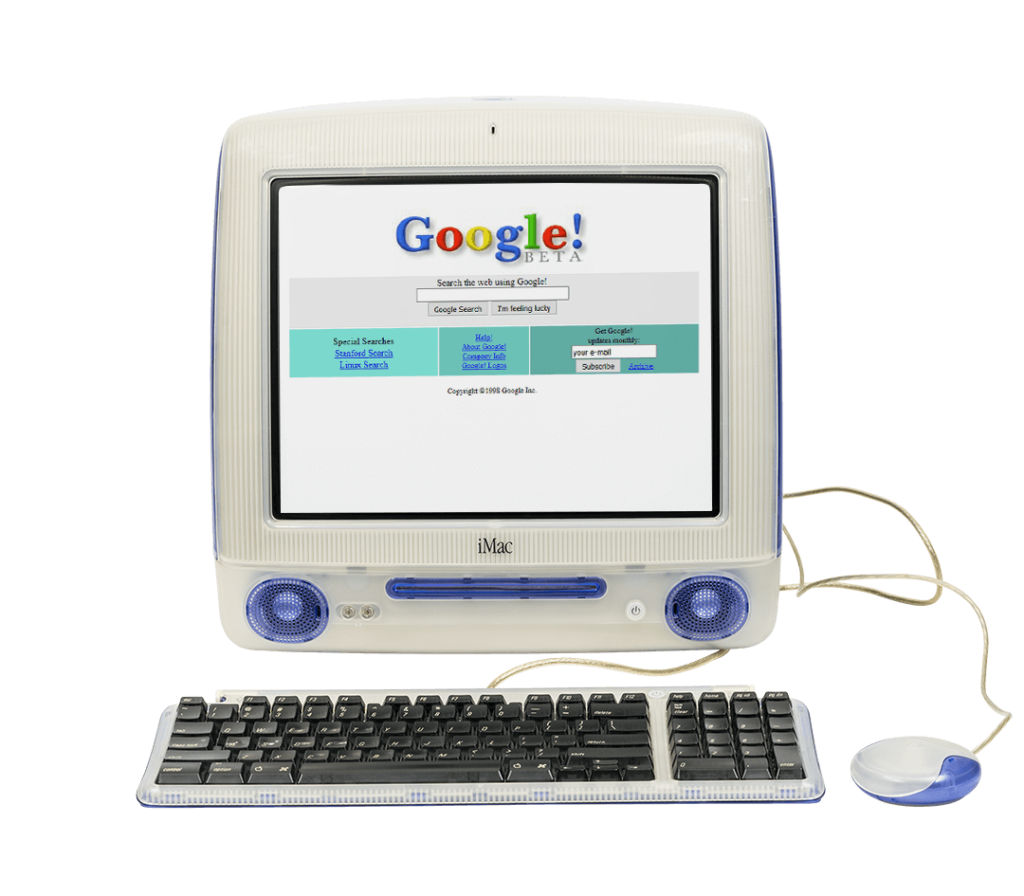
The PageRank algorithm, developed by Larry Page and Sergey Brin at Stanford University, represented a new approach to evaluating web pages. It assessed not only the content of a page but also the quality of the links leading to that page, to determine how reliable and relevant the information was.
The principle behind PageRank was simple: a page must be important and useful to the user if it has links from other pages, especially if those pages themselves are of high quality. This method of assessing page quality was inspired by academic citation, where a document’s importance is often judged by how many times it is cited by other authors. A link to a webpage acted like a recommendation, similar to word-of-mouth information sharing.
Using PageRank, Google was able to drastically improve the relevance and quality of search results. This was possible because PageRank leveraged the collective wisdom of the global internet, making it much harder to manipulate search rankings using simple local optimizations like keyword stuffing.
PageRank, combined with Google’s simple and user-friendly interface, quickly became popular, and Google soon became the number one search engine in the world. They maintained this market dominance by continually updating their algorithm and introducing new products. However, the core philosophy that links are a signal of quality remains an essential part of Google.
2000: A New Era
The year 2000 changed the fate of search engines by focusing on optimizing search results for relevance and speed. Users could get millions of results in an instant.
This period also marked the beginning of search engine optimization (SEO), as web developers and marketers began to understand how search algorithms worked and how they could influence their site’s rankings. The tactics they could use were somewhat simpler than today’s SEO strategies, tools, and techniques.
“Black hat” tactics used by SEO experts forced search engines to continually update their algorithms to ensure that users were always presented with the best possible page recommendations.
2007: The Internet in Your Pocket
On January 7, 2007, Apple founder Steve Jobs introduced the first iPhone, which changed browsing habits. The internet was now in your pocket, and mobile network operators quickly began offering mobile internet plans. These plans, along with the advanced technological solutions of the iPhone, allowed users to freely access the internet, further increasing the demand for mobile searches.
Users could now search for answers to their queries from anywhere, making search engine use a daily habit. The days of needing to sit at a computer to search for information were gone; now, all you had to do was unlock your smartphone and search. Despite continuous improvements in mobile internet speed, users often complained that searches took quite a long time.
Many websites were not optimized for mobile screens, making them uncomfortable for users.
To improve user experience, Google began prioritizing mobile-friendly websites. Sites optimized for mobile devices had a better chance of ranking higher in search results.
The Voice Search Revolution
Following the mobile search revolution came the voice search revolution. Digital assistants like Siri, Alexa, and Google Assistant were integrated into new smartphones and home devices, allowing users to ask questions by voice and receive answers in text or audio format. The ability to speak instead of typing became popular worldwide.
The breakthrough in voice technology meant that search engines had to adapt again and consider conversational search. Voice search queries are quite different from typed queries, often using more complex and natural language.
This shift to natural language queries requires search engines to understand and process spoken language.
While voice search is not yet as popular, it is predicted to become more widely used in the future.


